
What's Wicked?

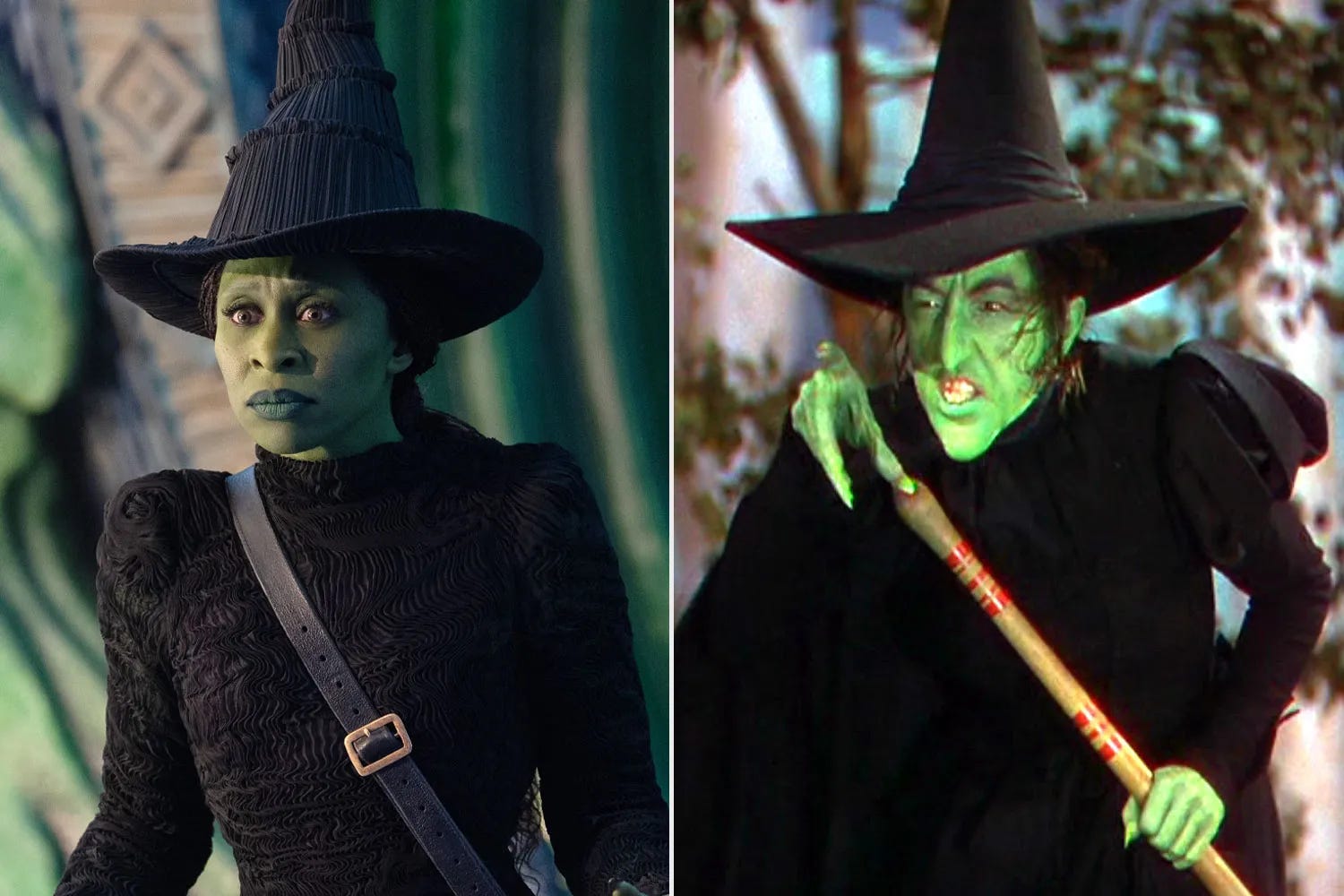
Like so many households, my family made the trek to the movie theatre in recent weeks to watch the finale to the Wicked movies. I don’t know about others, but I didn’t hold out a lot of hope when we watched the first one. My wife and I decided to rent the movie for our daughter after it came out on streaming on a lazy Saturday. We honestly wanted to lay down and take a nap while our daughter could enjoy the movie.
We all curled up in the basement on our couch to watch it, or secretly sleep as the lights were dropped low and the opening credits began. I always liked the Wizard of Oz as a kid and was intrigued at the notion of their being a different take on the old story, but I honestly figured it would just be another big box office movie made to attract the attention of youth that was shallow in nature and ruined by Hollywood.
Once the movie started, though, I kept finding my eyes were drawn back open not only by well timed and catchy songs, but also by intrigue at the depth of the character, Elphaba. I don’t think it’s spoiling anything to note that the green skinned, young witch, is the character who will eventually become The Wicked Witch of the West.
Early in the first movie I began to wonder if this was an Anakin Skywalker type transformation into Darth Vader where she would slowly descend into the dark side based on the way in which the world and experiences slowly corrupt her. I was pleasantly surprised to find that there was even more depth to this character and the story as a whole that actually demonstrated how it was really a story of deception, misunderstanding, and false perceptions.
The story of Wicked has got me thinking more about the nature of good and bad and how ill-conceived the whole concept is. Most people seem to believe there are objectively good and bad actions that often create objectively good and bad people.
It’s actually a compelling notion and one I’ve always wanted to believe to be true. It makes navigating the world so much easier and simplifies things so that you don’t have to think too hard about anything. It allows the world to easily fit into a box. The problem is that as you unpack these behaviors, things quickly become more nuanced and tricky.
Let’s just look at the difference in tales from the Wizard of Oz and Wicked. In the Wizard of Oz, the Wicked Witch essentially serves the classic trope of the morally evil archetype. We can probably think of people in the world who fit this description in our minds. It’s usually a political opponent, athlete we despise, or apparently a morally bankrupt celebrity. I’m sure you can picture at least one “purely evil” person in your mind.
However, when we examine the story from Wicked Witch to Elphaba, the story becomes much more nuanced and understandable. We find ourselves rooting for Elphaba as she fights a corrupt and oppressive system. The story doesn’t really change though, it just gets seen through a different lens. To Dorothy, she remains a Wicked Witch who seeks to destroy her simply for taking shoes that were gifted to her.
My point is that instead of seeing morality as a universal truth, we must accept that it is a purely subjective experience. The very nature that we can’t agree, universally, on what constitutes “good” from “bad” suggests that the concept of morality is completely subjective. We all get to decide what constitutes a moral act and even those definitions become more fluid based on our lived experiences. That’s how people come to disagree about the morality of an issue that seems clear. Even acts like murder get more ambiguous once dissected. Murder through one lens is often righteous through another.
I get it. It’s easier to say that our side is good and the other side is bad. The same goes with how we write our history books. We like clean stories of heroes and villains to make clear that justice has been served; or not. When we get into the dirty details of any situation, seemingly simple stories get profoundly more complex and the situation becomes so much more ambiguous: cough cough Wicked Witch vs Elphaba.
Why does all this matter? Why am I making you consider the nuances of morality? Well, the thing I’ve noticed over the years, especially with how social media serves to simplify and tribalize groups, more language has begun to be used about how bad or evil certain groups of people are. In our country’s history, these tactics have been used to convince entire groups that another race or sex is inherently inferior or bad. Now I see it being used to tribalize politics to a point where we often deem anything the other side does as “bad” and justifies any action the leaders do as “good”. The very use of “good” and “bad” language naturally dichotomizes groups against each other and turns simple and often good faith disagreement into “us” versus “them”.
I want to make something clear. I am not against the pursuit of society’s attempt to make morality more objective. That’s why we have laws. We take socially agreed upon beliefs in morality, and use those beliefs as a baseline to develop laws and hold people accountable. Even if imperfect, I like this system much better than the alternative. I also don’t want to discourage people from seeking their own morality. My point is not to suggest that morality is an illusion, but rather to remind people that morality, while still very important, is subjective in nature. We strive for objective rational moral truth, but at its core it’s just not. Morality is bred from one’s upbringing, culture, and time, but its essence remains personal; remains uniquely yours.
If you really look at Wicked closely, the story isn’t a reversal of the “good” characters in the Wizard of Oz to “bad” and vice versa. It actually shows the true nuance of good versus bad and how much of those beliefs depend on the stories we hear and the narratives created. It’s not that good people do bad things, or vice versa, but that we all do things within a context that makes sense to us individually. Good and bad actually becomes irrelevant. It’s the meaning that drives us.
Whether she’s Elphabe or the Wicked Witch depends on the story you’re told and the pursuit of morality is found in finding presence and holding space in the ambiguous middle where the complicated truth is found.
If you followed the Wicked rabbit hole further down to the Wizard’s perspective, the story would inevitably become more ambiguous and the cloud of moral clarity would become more gray. Never are people purely bad, they just become that when subjective “truth” and the story we tell each other grows strong enough collectively that they are believed to be objectively bad or good. However, once we unpack people’s decisions and understand them phenomenologically, the myths we’re told of good versus bad dissipate leaving only understandable, if not sometimes upsetting or even disturbing, decisions. The decisions remain made for specific reasons and folks convince themselves of the morality of it on their own. So I ask, what exactly is wicked? Only you can answer that.
-Luke
They remind us that morality isn’t black or white, just deeply human. Wicked really proves how perspective can change everything.
Thanks for sharing
Hmmm, agree that morality is a combination of upbringing,culture and time. Makes total sense that those different experiences could change your morality. Hadn’t thought along lines. Maybe, I need to give more consideration and grace to those I feel are wrong in my book. Interesting thoughts.