
Diagnosing The Soul
Why Psychology Needs to Separate From the Medical Model for Good

My field has long been in the cross hairs between the medical profession and what could be seen as humanism. For decades, we’ve tried to align ourselves with the medical world and maybe for good reason.
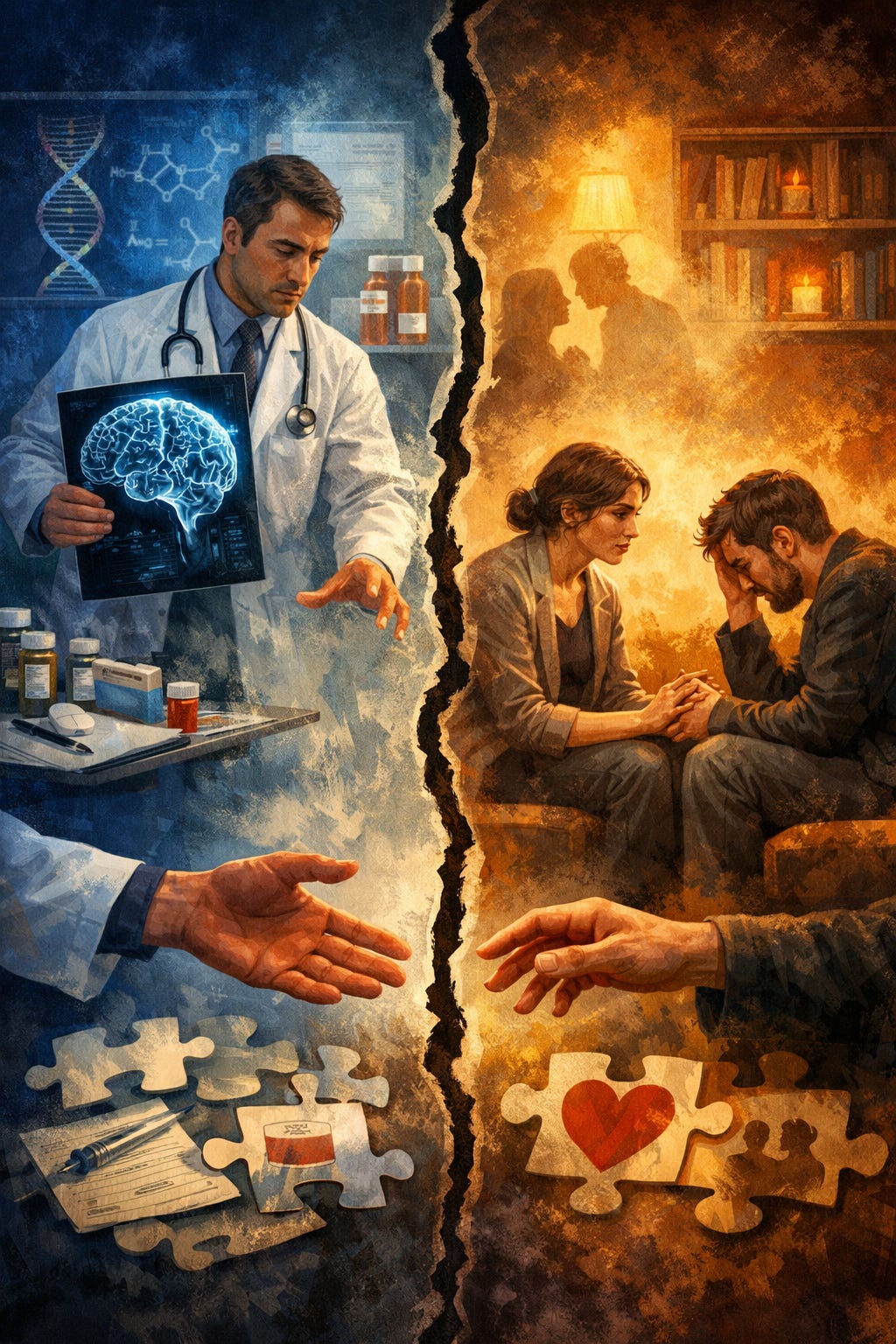
Modern medicine has been revolutionized over the last century, primarily by the scientific rigor that has evolved from the medical model. For those unfamiliar, the medical model is a method of understanding illness as rooted in biological or physiological abnormalities. The focus of the medical model is on diagnosing, treating, and eventually curing through scientific, professional intervention, often via medication or medical procedures to fix the underlying problem. Health, in the medical model, is viewed as the absence of disease that sees the problem (illness) as residing within the individual.
The medical model is certainly not perfect, and has had its share of disappointments and letdowns. We often chase cures and research that never come to fruition. We throw millions of dollars at treatments or medications that don’t end up working, but at the end of the day, this style of observing, studying, and treating illnesses has been nothing short of a miracle compared to the historical perspectives that often saw illness as evidence of sin, moral weakness, or social deviance. Despite its failures, the medical model has continued to produce revolutionary treatments and even cures for ailments once thought impossible to treat. With modern medicine there is even hope of curing cancer.
I’m a firm believer in the validity of the medical model. When it comes to psychology, however, I become a bit of a skeptic. Over the last century, the field of psychiatry and eventually psychology have felt pulled and even compelled to fit their practice within the medical model. It makes sense, but not necessarily due to any scientific discovery to support it. Psychology has never truly fit within the medical model, but we were pulled in that direction for three big reasons: insurance reimbursement has always required an underlying medical condition, pharmacological influence, and the prestige and legitimacy of being aligned with medicine. I’m not going to dig into these here, but these are topics you can readily find on your own.
What isn’t mentioned in any of this, is a true scientific understanding of psychopathology. Over and over again, we’ve attempted to map out psychiatric disorders in the brain. We proclaimed the 90s to be the Decade of the Brain where we expected to link neural circuits to behavior, identify biological causes of psychiatric disorders, and even align neuroscience directly into diagnostics and treatment. Even after billions of dollars were spent to validate the chemical imbalance theory of depression and other disorders, we still have no clear evidence that depression or any disorder is caused by a chemical imbalance. In fact, even though psychiatric medications work for a lot of people, we still don’t have a complete understanding as to why they work for many people.
I should emphasize that this pursuit of knowledge should not be considered to be done in vain. Although we didn’t learn what we thought we would, it helped us switch to a more nuanced model for psychology that we still use today; the biopsychosocial model. We’ve determined that while there is some indication of biological factors for diagnoses, equal measure is given to the person’s unique psychology and social environment in which they grew up and currently live. It’s a more ambiguous model that factors in what psychologists have long known was at the center of depression, anxiety, psychosis, etc.
Here is where I really start to struggle. Although we claim to come from a biopsychosocial model, we appear to remain stuck in the old ideas of the medical model. Why do I say that? Our field remains stuck in standardized approaches to treating inherently unique human beings. Everywhere I turn, there is a new continuing education credit on “evidence based treatment for…”.
Your first response may be, “but what wrong with evidence based” practices? Isn’t that what we should strive for? This is where psychology inevitably shifts away from the medical model. The medical world studies disease, which behave and respond to treatments in predictable and consistent ways. If your blood sugar rises, and your body doesn’t produce insulin, you can expect a certain amount of insulin injected into your body to lower your blood sugar to a safe level. It’s a standard treatment that has been researched thoroughly, standardized, and can now be used safely.
The problem in psychological research is that some of the most important parts about a person’s experience can’t be measured in simple scales. We’ve tried to do that by focusing on symptom reduction. Measure how many symptoms of depression Mike has, give him the eight treatment sessions, and measure if his depression goes up, down, or stays the same over time. Again, on paper that sounds nice, but what does that actually say about treating Mike’s experience of depression in the world? I would argue very little.
If his symptoms went from severe to moderate, but he still personally identifies as extremely depressed, did the treatment work? If he stops attempting suicide but still thinks about it constantly, is he better? But that’s how most psychological research works. We look at a large chunk of people and measure their symptoms before treatment, during it, and after to see if things improve. We do this because it is the easiest way to measure symptom reduction and follows the medical definition of improvement. The problem is that it says nothing about the humans it proclaims to treat.
As I’ve written in previous newsletters, the field of psychology is the literal study of the soul. We study humans down to their basic essence and studying a complex soul as diseased takes the humanity out of our practice. I see this in how we try to standardize care for people that rarely fit perfectly into a box. I see it in how research is biased towards things that are easily measured but ignore the most important things that struggle to be measured.
That’s why cognitive behavioral therapy (CBT) is most popular, because it’s formulaic, consistent across practitioners, easily studied, and thus easily standardized and scaled. It fits best within the medical model. Other modalities of treatment often look very different from clinician to clinician and may be more phenomenological, meaning they focus on the specific individual and not the broader diagnosis. You can’t measure these ways of working the way you can monitoring symptoms, common behaviors, and standardized treatment plans. Does that make them less effective? In our current system, the answer is yes. I’m not saying that CBT or other modalities are necessarily bad, I just worry about over standardization and medicalization in a field that is supposed to be focused on individual psyches; souls.
The best evidence I can give you of this is that the best indicator of good outcomes in therapy has nothing to do with therapeutic modality, but instead is based on the therapeutic relationship. Consistently, we find that when the client feels understood, isn’t judged, and deeply trusts his therapist, he tends to get better. This suggests that the magic of therapy is found in the human aspects of therapy; the moments we laugh together, the moments we cry together, the moments we fall apart, and the moments we put ourselves back together. These aren’t traits that can be easily measured and so they aren’t, but they are the parts that make this space work; not a standardized treatment system.
I’m not here to argue that we should give up traditional research altogether. It certainly has its place. What I’m arguing is that we need to focus on smaller, more intimate, phenomenological studies to start to get an understanding of what makes up these small, beautiful moments in therapy where the healing actually happens. I’m asking that we remember our humanity in therapy and not settle for a disease model that requires a diagnosis to get insurance coverage. Psychology is certainly adjacent to the medical world, but we are something entirely different. It’s time researchers, insurance companies, and our field recognize that as the truth and we return to our roots; the souls of humanity.
-Luke
As someone with a broad set of life experiences— navigating supporting a child with schizophrenia, having another child who has had multiple diagnoses of cancer from birth until now, and holding a MSc psychology, I am so incredibly thankful that this conversation is happening.
There are many things we can attribute to medical science— my daughters would not be here without it. But so much of their growth and development has come from the deep understanding and nurturing we’ve developed with them over the years.
I firmly believe that support circles for people going through mental crises can be taught to improve outcomes.
Cheers.
What the medical model does well is identify and treat the agent causing the problem. If you get sick and test positive for strep, the doctor treats the bacteria. Eliminate the agent, and the symptoms resolve. That model works beautifully when the cause is identifiable and direct.
Psychology is often working in a very different lane.
Most of the time, we are not treating a single, clear agent that is causing the experience. We are working with the experience itself — the person’s thoughts, emotions, behaviors, and the meaning they’re making of what’s happening. Sometimes biology is part of the equation, yes. But often there is no single “bacteria” to target.
If a physician tried to treat only the experience of strep, such as the fatigue, the sore throat, the irritability, without addressing the infection, it would be inefficient and inconsistent. They can standardize care because they can target the cause.
Now take depression. In many cases, we don’t have a single, identifiable cause to eliminate. If it’s situational — loss, death, betrayal, major transition — we may understand the context. But we cannot remove the loss the way we remove a virus. Even if the depression is biological, we are often managing vulnerability rather than curing a discrete invader.
So we treat the experience. We work with how someone is living through it. We address patterns. We build coping. We help them metabolize grief. We help them make meaning.
That is much harder to standardize.
We can identify symptom clusters. We can track trends. We can study what tends to help. But we are not curing people of emotional responses to being human. We are helping them navigate those responses.
If we move away from a strict “cure it” framework and toward a “support and integrate” framework, we may make more progress. Emotional experiences are not infections. They are responses — to life, to biology, to relationships, to change.
And this is why, over and over, the research shows that the therapeutic relationship matters so much. It is in relationship with a person who is attuned, consistent, and showing up specifically for us, that change becomes possible.
That does not dismiss severe mental illness or the role of psychotropics and neuroscience. In many cases, brain-based interventions are essential. But even there, medication often stabilizes the system so that relational and psychological work can actually take hold.
Medicine can often remove the agent.
Psychology helps people live through what cannot be removed.
Thanks for tackling this topic, Luke!